 전출처 : 로쟈 > 앙드레 브르통의 '초현실주의 선언'(자료)

Manifesto of Surrealism
by
André Breton
1924
So strong is the belief in life, in what is most fragile in life--real life, I mean--that in the end this belief is lost. Man, that inveterate dreamer, daily more discontent with his destiny, has trouble assessing the objects he has been led to use, objects that his nonchalance has brought his way, or that he has earned through his own efforts, almost always through his own efforts, for he has agreed to work, at least he has not refused to try his luck (or what he calls his luck!). At this point he feels extremely modest: he knows what women he has had, what silly affairs he has been involved in; he is unimpressed by his wealth or his poverty, in this respect he is still a newborn babe and, as for the approval of his conscience, I confess that he does very nicely without it. If he still retains a certain lucidity, all he can do is turn back toward his childhood which, however his guides and mentors may have botched it, still strikes him as somehow charming. There, the absence of any known restrictions allows him the perspective of several lives lived at once; this illusion becomes firmly rooted within him; now he is only interested in the fleeting, the extreme facility of everything. Children set off each day without a worry in the world. Everything is near at hand, the worst material conditions are fine. The woods are white or black, one will never sleep.
But it is true that we would not dare venture so far, it is not merely a question of distance. Threat is piled upon threat, one yields, abandons a portion of the terrain to be conquered. This imagination which knows no bounds is henceforth allowed to be exercised only in strict accordance with the laws of an arbitrary utility; it is incapable of assuming this inferior role for very long and, in the vicinity of the twentieth year, generally prefers to abandon man to his lusterless fate.
Though he may later try to pull himself together on occasion, having felt that he is losing by slow degrees all reason for living, incapable as he has become of being able to rise to some exceptional situation such as love, he will hardly succeed. This is because he henceforth belongs body and soul to an imperative practical necessity which demands his constant attention. None of his gestures will be expansive, none of his ideas generous or far-reaching. In his mind’s eye, events real or imagined will be seen only as they relate to a welter of similar events, events in which he has not participated, abortive events. What am I saying: he will judge them in relationship to one of these events whose consequences are more reassuring than the others. On no account will he view them as his salvation.
Beloved imagination, what I most like in you is your unsparing quality.
There remains madness, "the madness that one locks up," as it has aptly been described. That madness or another.... We all know, in fact, that the insane owe their incarceration to a tiny number of legally reprehensible acts and that, were it not for these acts their freedom (or what we see as their freedom) would not be threatened. I am willing to admit that they are, to some degree, victims of their imagination, in that it induces them not to pay attention to certain rules--outside of which the species feels threatened--which we are all supposed to know and respect. But their profound indifference to the way in which we judge them, and even to the various punishments meted out to them, allows us to suppose that they derive a great deal of comfort and consolation from their imagination, that they enjoy their madness sufficiently to endure the thought that its validity does not extend beyond themselves. And, indeed, hallucinations, illusions, etc., are not a source of trifling pleasure. The best controlled sensuality partakes of it, and I know that there are many evenings when I would gladly that pretty hand which, during the last pages of Taine’s L’Intelligence, indulges in some curious misdeeds. I could spend my whole life prying loose the secrets of the insane. These people are honest to a fault, and their naiveté has no peer but my own. Christopher Columbus should have set out to discover America with a boatload of madmen. And note how this madness has taken shape, and endured.
It is not the fear of madness which will oblige us to leave the flag of imagination furled.
The case against the realistic attitude demands to be examined, following the case against the materialistic attitude. The latter, more poetic in fact than the former, admittedly implies on the part of man a kind of monstrous pride which, admittedly, is monstrous, but not a new and more complete decay. It should above all be viewed as a welcome reaction against certain ridiculous tendencies of spiritualism. Finally, it is not incompatible with a certain nobility of thought.
By contrast, the realistic attitude, inspired by positivism, from Saint Thomas Aquinas to Anatole France, clearly seems to me to be hostile to any intellectual or moral advancement. I loathe it, for it is made up of mediocrity, hate, and dull conceit. It is this attitude which today gives birth to these ridiculous books, these insulting plays. It constantly feeds on and derives strength from the newspapers and stultifies both science and art by assiduously flattering the lowest of tastes; clarity bordering on stupidity, a dog’s life. The activity of the best minds feels the effects of it; the law of the lowest common denominator finally prevails upon them as it does upon the others. An amusing result of this state of affairs, in literature for example, is the generous supply of novels. Each person adds his personal little "observation" to the whole. As a cleansing antidote to all this, M. Paul Valéry recently suggested that an anthology be compiled in which the largest possible number of opening passages from novels be offered; the resulting insanity, he predicted, would be a source of considerable edification. The most famous authors would be included. Such a though reflects great credit on Paul Valéry who, some time ago, speaking of novels, assured me that, so far as he was concerned, he would continue to refrain from writing: "The Marquise went out at five." But has he kept his word?
If the purely informative style, of which the sentence just quoted is a prime example, is virtually the rule rather than the exception in the novel form, it is because, in all fairness, the author’s ambition is severely circumscribed. The circumstantial, needlessly specific nature of each of their notations leads me to believe that they are perpetrating a joke at my expense. I am spared not even one of the character’s slightest vacillations: will he be fairhaired? what will his name be? will we first meet him during the summer? So many questions resolved once and for all, as chance directs; the only discretionary power left me is to close the book, which I am careful to do somewhere in the vicinity of the first page. And the descriptions! There is nothing to which their vacuity can be compared; they are nothing but so many superimposed images taken from some stock catalogue, which the author utilizes more and more whenever he chooses; he seizes the opportunity to slip me his postcards, he tries to make me agree with him about the clichés:
The small room into which the young man was shown was covered with yellow wallpaper: there were geraniums in the windows, which were covered with muslin curtains; the setting sun cast a harsh light over the entire setting.... There was nothing special about the room. The furniture, of yellow wood, was all very old. A sofa with a tall back turned down, an oval table opposite the sofa, a dressing table and a mirror set against the pierglass, some chairs along the walls, two or three etchings of no value portraying some German girls with birds in their hands--such were the furnishings. (Dostoevski, Crime and Punishment)
I am in no mood to admit that the mind is interested in occupying itself with such matters, even fleetingly. It may be argued that this school-boy description has its place, and that at this juncture of the book the author has his reasons for burdening me. Nevertheless he is wasting his time, for I refuse to go into his room. Others’ laziness or fatigue does not interest me. I have too unstable a notion of the continuity of life to equate or compare my moments of depression or weakness with my best moments. When one ceases to feel, I am of the opinion one should keep quiet. And I would like it understood that I am not accusing or condemning lack of originality as such. I am only saying that I do not take particular note of the empty moments of my life, that it may be unworthy for any man to crystallize those which seem to him to be so. I shall, with your permission, ignore the description of that room, and many more like it.
Not so fast, there; I’m getting into the area of psychology, a subject about which I shall be careful not to joke.
The author attacks a character and, this being settled upon, parades his hero to and fro across the world. No matter what happens, this hero, whose actions and reactions are admirably predictable, is compelled not to thwart or upset--even though he looks as though he is--the calculations of which he is the object. The currents of life can appear to lift him up, roll him over, cast him down, he will still belong to this readymade human type. A simple game of chess which doesn't interest me in the least--man, whoever he may be, being for me a mediocre opponent. What I cannot bear are those wretched discussions relative to such and such a move, since winning or losing is not in question. And if the game is not worth the candle, if objective reason does a frightful job--as indeed it does--of serving him who calls upon it, is it not fitting and proper to avoid all contact with these categories? "Diversity is so vast that every different tone of voice, every step, cough, every wipe of the nose, every sneeze...."* (Pascal.) If in a cluster of grapes there are no two alike, why do you want me to describe this grape by the other, by all the others, why do you want me to make a palatable grape? Our brains are dulled by the incurable mania of wanting to make the unknown known, classifiable. The desire for analysis wins out over the sentiments.** (Barrès, Proust.) The result is statements of undue length whose persuasive power is attributable solely to their strangeness and which impress the reader only by the abstract quality of their vocabulary, which moreover is ill-defined. If the general ideas that philosophy has thus far come up with as topics of discussion revealed by their very nature their definitive incursion into a broader or more general area. I would be the first to greet the news with joy. But up till now it has been nothing but idle repartee; the flashes of wit and other niceties vie in concealing from us the true thought in search of itself, instead of concentrating on obtaining successes. It seems to me that every act is its own justification, at least for the person who has been capable of committing it, that it is endowed with a radiant power which the slightest gloss is certain to diminish. Because of this gloss, it even in a sense ceases to happen. It gains nothing to be thus distinguished. Stendhal's heroes are subject to the comments and appraisals--appraisals which are more or less successful--made by that author, which add not one whit to their glory. Where we really find them again is at the point at which Stendahl has lost them.
We are still living under the reign of logic: this, of course, is what I have been driving at. But in this day and age logical methods are applicable only to solving problems of secondary interest. The absolute rationalism that is still in vogue allows us to consider only facts relating directly to our experience. Logical ends, on the contrary, escape us. It is pointless to add that experience itself has found itself increasingly circumscribed. It paces back and forth in a cage from which it is more and more difficult to make it emerge. It too leans for support on what is most immediately expedient, and it is protected by the sentinels of common sense. Under the pretense of civilization and progress, we have managed to banish from the mind everything that may rightly or wrongly be termed superstition, or fancy; forbidden is any kind of search for truth which is not in conformance with accepted practices. It was, apparently, by pure chance that a part of our mental world which we pretended not to be concerned with any longer--and, in my opinion by far the most important part--has been brought back to light. For this we must give thanks to the discoveries of Sigmund Freud. On the basis of these discoveries a current of opinion is finally forming by means of which the human explorer will be able to carry his investigation much further, authorized as he will henceforth be not to confine himself solely to the most summary realities. The imagination is perhaps on the point of reasserting itself, of reclaiming its rights. If the depths of our mind contain within it strange forces capable of augmenting those on the surface, or of waging a victorious battle against them, there is every reason to seize them--first to seize them, then, if need be, to submit them to the control of our reason. The analysts themselves have everything to gain by it. But it is worth noting that no means has been designated a priori for carrying out this undertaking, that until further notice it can be construed to be the province of poets as well as scholars, and that its success is not dependent upon the more or less capricious paths that will be followed.
Freud very rightly brought his critical faculties to bear upon the dream. It is, in fact, inadmissible that this considerable portion of psychic activity (since, at least from man's birth until his death, thought offers no solution of continuity, the sum of the moments of the dream, from the point of view of time, and taking into consideration only the time of pure dreaming, that is the dreams of sleep, is not inferior to the sum of the moments of reality, or, to be more precisely limiting, the moments of waking) has still today been so grossly neglected. I have always been amazed at the way an ordinary observer lends so much more credence and attaches so much more importance to waking events than to those occurring in dreams. It is because man, when he ceases to sleep, is above all the plaything of his memory, and in its normal state memory takes pleasure in weakly retracing for him the circumstances of the dream, in stripping it of any real importance, and in dismissing the only determinant from the point where he thinks he has left it a few hours before: this firm hope, this concern. He is under the impression of continuing something that is worthwhile. Thus the dream finds itself reduced to a mere parenthesis, as is the night. And, like the night, dreams generally contribute little to furthering our understanding. This curious state of affairs seems to me to call for certain reflections:
1) Within the limits where they operate (or are thought to operate) dreams give every evidence of being continuous and show signs of organization. Memory alone arrogates to itself the right to excerpt from dreams, to ignore the transitions, and to depict for us rather a series of dreams than the dream itself. By the same token, at any given moment we have only a distinct notion of realities, the coordination of which is a question of will.* (Account must be taken of the depth of the dream. For the most part I retain only what I can glean from its most superficial layers. What I most enjoy contemplating about a dream is everything that sinks back below the surface in a waking state, everything I have forgotten about my activities in the course of the preceding day, dark foliage, stupid branches. In "reality," likewise, I prefer to fall.) What is worth noting is that nothing allows us to presuppose a greater dissipation of the elements of which the dream is constituted. I am sorry to have to speak about it according to a formula which in principle excludes the dream. When will we have sleeping logicians, sleeping philosophers? I would like to sleep, in order to surrender myself to the dreamers, the way I surrender myself to those who read me with eyes wide open; in order to stop imposing, in this realm, the conscious rhythm of my thought. Perhaps my dream last night follows that of the night before, and will be continued the next night, with an exemplary strictness. It's quite possible, as the saying goes. And since it has not been proved in the slightest that, in doing so, the "reality" with which I am kept busy continues to exist in the state of dream, that it does not sink back down into the immemorial, why should I not grant to dreams what I occasionally refuse reality, that is, this value of certainty in itself which, in its own time, is not open to my repudiation? Why should I not expect from the sign of the dream more than I expect from a degree of consciousness which is daily more acute? Can't the dream also be used in solving the fundamental questions of life? Are these questions the same in one case as in the other and, in the dream, do these questions already exist? Is the dream any less restrictive or punitive than the rest? I am growing old and, more than that reality to which I believe I subject myself, it is perhaps the dream, the difference with which I treat the dream, which makes me grow old.
2) Let me come back again to the waking state. I have no choice but to consider it a phenomenon of interference. Not only does the mind display, in this state, a strange tendency to lose its bearings (as evidenced by the slips and mistakes the secrets of which are just beginning to be revealed to us), but, what is more, it does not appear that, when the mind is functioning normally, it really responds to anything but the suggestions which come to it from the depths of that dark night to which I commend it. However conditioned it may be, its balance is relative. It scarcely dares express itself and, if it does, it confines itself to verifying that such and such an idea, or such and such a woman, has made an impression on it. What impression it would be hard pressed to say, by which it reveals the degree of its subjectivity, and nothing more. This idea, this woman, disturb it, they tend to make it less severe. What they do is isolate the mind for a second from its solvent and spirit it to heaven, as the beautiful precipitate it can be, that it is. When all else fails, it then calls upon chance, a divinity even more obscure than the others to whom it ascribes all its aberrations. Who can say to me that the angle by which that idea which affects it is offered, that what it likes in the eye of that woman is not precisely what links it to its dream, binds it to those fundamental facts which, through its own fault, it has lost? And if things were different, what might it be capable of? I would like to provide it with the key to this corridor.
3) The mind of the man who dreams is fully satisfied by what happens to him. The agonizing question of possibility is no longer pertinent. Kill, fly faster, love to your heart's content. And if you should die, are you not certain of reawaking among the dead? Let yourself be carried along, events will not tolerate your interference. You are nameless. The ease of everything is priceless.
What reason, I ask, a reason so much vaster than the other, makes dreams seem so natural and allows me to welcome unreservedly a welter of episodes so strange that they could confound me now as I write? And yet I can believe my eyes, my ears; this great day has arrived, this beast has spoken.
If man's awaking is harder, if it breaks the spell too abruptly, it is because he has been led to make for himself too impoverished a notion of atonement.
4) From the moment when it is subjected to a methodical examination, when, by means yet to be determined, we succeed in recording the contents of dreams in their entirety (and that presupposes a discipline of memory spanning generations; but let us nonetheless begin by noting the most salient facts), when its graph will expand with unparalleled volume and regularity, we may hope that the mysteries which really are not will give way to the great Mystery. I believe in the future resolution of these two states, dream and reality, which are seemingly so contradictory, into a kind of absolute reality, a surreality, if one may so speak. It is in quest of this surreality that I am going, certain not to find it but too unmindful of my death not to calculate to some slight degree the joys of its possession.
A story is told according to which Saint-Pol-Roux, in times gone by, used to have a notice posted on the door of his manor house in Camaret, every evening before he went to sleep, which read: THE POET IS WORKING.
A great deal more could be said, but in passing I merely wanted to touch upon a subject which in itself would require a very long and much more detailed discussion; I shall come back to it. At this juncture, my intention was merely to mark a point by noting the hate of the marvelous which rages in certain men, this absurdity beneath which they try to bury it. Let us not mince words: the marvelous is always beautiful, anything marvelous is beautiful, in fact only the marvelous is beautiful.
In the realm of literature, only the marvelous is capable of fecundating works which belong to an inferior category such as the novel, and generally speaking, anything that involves storytelling. Lewis' The Monk is an admirable proof of this. It is infused throughout with the presence of the marvelous. Long before the author has freed his main characters from all temporal constraints, one feels them ready to act with an unprecedented pride. This passion for eternity with which they are constantly stirred lends an unforgettable intensity to their torments, and to mine. I mean that this book, from beginning to end, and in the purest way imaginable, exercises an exalting effect only upon that part of the mind which aspires to leave the earth and that, stripped of an insignificant part of its plot, which belongs to the period in which it was written, it constitutes a paragon of precision and innocent grandeur.* (What is admirable about the fantastic is that there is no longer anything fantastic: there is only the real.) It seems to me none better has been done, and that the character of Mathilda in particular is the most moving creation that one can credit to this figurative fashion in literature. She is less a character than a continual temptation. And if a character is not a temptation, what is he? An extreme temptation, she. In The Monk the "nothing is impossible for him who dares try" gives it its full, convincing measure. Ghosts play a logical role in the book, since the critical mind does not seize them in order to dispute them. Ambrosio's punishment is likewise treated in a legitimate manner, since it is finally accepted by the critical faculty as a natural denouement.
It may seem arbitrary on my part, when discussing the marvelous, to choose this model, from which both the Nordic literatures and Oriental literatures have borrowed time and time again, not to mention the religious literatures of every country. This is because most of the examples which these literatures could have furnished me with are tainted by puerility, for the simple reason that they are addressed to children. At an early age children are weaned on the marvelous, and later on they fail to retain a sufficient virginity of mind to thoroughly enjoy fairy tales. No matter how charming they may be, a grown man would think he were reverting to childhood by nourishing himself on fairy tales, and I am the first to admit that all such tales are not suitable for him. The fabric of adorable improbabilities must be made a trifle more subtle the older we grow, and we are still at the age of waiting for this kind of spider.... But the faculties do not change radically. Fear, the attraction of the unusual, chance, the taste for things extravagant are all devices which we can always call upon without fear of deception. There are fairy tales to be written for adults, fairy tales still almost blue.
The marvelous is not the same in every period of history: it partakes in some obscure way of a sort of general revelation only the fragments of which come down to us: they are the romantic ruins, the modern mannequin, or any other symbol capable of affecting the human sensibility for a period of time. In these areas which make us smile, there is still portrayed the incurable human restlessness, and this is why I take them into consideration and why I judge them inseparable from certain productions of genius which are, more than the others, painfully afflicted by them. They are Villon's gibbets, Racine's Greeks, Baudelaire's couches. They coincide with an eclipse of the taste I am made to endure, I whose notion of taste is the image of a big spot. Amid the bad taste of my time I strive to go further than anyone else. It would have been I, had I lived in 1820, I "the bleeding nun," I who would not have spared this cunning and banal "let us conceal" whereof the parodical Cuisin speaks, it would have been I, I who would have reveled in the enormous metaphors, as he says, all phases of the "silver disk." For today I think of a castle, half of which is not necessarily in ruins; this castle belongs to me, I picture it in a rustic setting, not far from Paris. The outbuildings are too numerous to mention, and, as for the interior, it has been frightfully restored, in such manner as to leave nothing to be desired from the viewpoint of comfort. Automobiles are parked before the door, concealed by the shade of trees. A few of my friends are living here as permanent guests: there is Louis Aragon leaving; he only has time enough to say hello; Philippe Soupault gets up with the stars, and Paul Eluard, our great Eluard, has not yet come home. There are Robert Desnos and Roger Vitrac out on the grounds poring over an ancient edict on duelling; Georges Auric, Jean Paulhan; Max Morise, who rows so well, and Benjamin Péret, busy with his equations with birds; and Joseph Delteil; and Jean Carrive; and Georges Limbour, and Georges Limbours (there is a whole hedge of Georges Limbours); and Marcel Noll; there is T. Fraenkel waving to us from his captive balloon, Georges Malkine, Antonin Artaud, Francis Gérard, Pierre Naville, J.-A. Boiffard, and after them Jacques Baron and his brother, handsome and cordial, and so many others besides, and gorgeous women, I might add. Nothing is too good for these young men, their wishes are, as to wealth, so many commands. Francis Picabia comes to pay us a call, and last week, in the hall of mirrors, we received a certain Marcel Duchamp whom we had not hitherto known. Picasso goes hunting in the neighborhood. The spirit of demoralization has elected domicile in the castle, and it is with it we have to deal every time it is a question of contact with our fellowmen, but the doors are always open, and one does not begin by "thanking" everyone, you know. Moreover, the solitude is vast, we don't often run into one another. And anyway, isn't what matters that we be the masters of ourselves, the masters of women, and of love too?
I shall be proved guilty of poetic dishonesty: everyone will go parading about saying that I live on the rue Fontaine and that he will have none of the water that flows therefrom. To be sure! But is he certain that this castle into which I cordially invite him is an image? What if this castle really existed! My guests are there to prove it does; their whim is the luminous road that leads to it. We really live by our fantasies when we give free reign to them. And how could what one might do bother the other, there, safely sheltered from the sentimental pursuit and at the trysting place of opportunities?
Man proposes and disposes. He and he alone can determine whether he is completely master of himself, that is, whether he maintains the body of his desires, daily more formidable, in a state of anarchy. Poetry teaches him to. It bears within itself the perfect compensation for the miseries we endure. It can also be an organizer, if ever, as the result of a less intimate disappointment, we contemplate taking it seriously. The time is coming when it decrees the end of money and by itself will break the bread of heaven for the earth! There will still be gatherings on the public squares, and movements you never dared hope participate in. Farewell to absurd choices, the dreams of dark abyss, rivalries, the prolonged patience, the flight of the seasons, the artificial order of ideas, the ramp of danger, time for everything! May you only take the trouble to practice poetry. Is it not incumbent upon us, who are already living off it, to try and impose what we hold to be our case for further inquiry?
It matters not whether there is a certain disproportion between this defense and the illustration that will follow it. It was a question of going back to the sources of poetic imagination and, what is more, of remaining there. Not that I pretend to have done so. It requires a great deal of fortitude to try to set up one's abode in these distant regions where everything seems at first to be so awkward and difficult, all the more so if one wants to try to take someone there. Besides, one is never sure of really being there. If one is going to all that trouble, one might as well stop off somewhere else. Be that as it may, the fact is that the way to these regions is clearly marked, and that to attain the true goal is now merely a matter of the travelers' ability to endure.
We are all more or less aware of the road traveled. I was careful to relate, in the course of a study of the case of Robert Desnos entitled ENTRÉE DES MÉDIUMS,* (See Les Pas perdus, published by N.R.F.) that I had been led to" concentrate my attention on the more or less partial sentences which, when one is quite alone and on the verge of falling asleep, become perceptible for the mind without its being possible to discover what provoked them." I had then just attempted the poetic adventure with the minimum of risks, that is, my aspirations were the same as they are today but I trusted in the slowness of formulation to keep me from useless contacts, contacts of which I completely disapproved. This attitude involved a modesty of thought certain vestiges of which I still retain. At the end of my life, I shall doubtless manage to speak with great effort the way people speak, to apologize for my voice and my few remaining gestures. The virtue of the spoken word (and the written word all the more so) seemed to me to derive from the faculty of foreshortening in a striking manner the exposition (since there was exposition) of a small number of facts, poetic or other, of which I made myself the substance. I had come to the conclusion that Rimbaud had not proceeded any differently. I was composing, with a concern for variety that deserved better, the final poems of Mont de piété, that is, I managed to extract from the blank lines of this book an incredible advantage. These lines were the closed eye to the operations of thought that I believed I was obliged to keep hidden from the reader. It was not deceit on my part, but my love of shocking the reader. I had the illusion of a possible complicity, which I had more and more difficulty giving up. I had begun to cherish words excessively for the space they allow around them, for their tangencies with countless other words which I did not utter. The poem BLACK FOREST derives precisely from this state of mind. It took me six months to write it, and you may take my word for it that I did not rest a single day. But this stemmed from the opinion I had of myself in those days, which was high, please don't judge me too harshly. I enjoy these stupid confessions. At that point cubist pseudo-poetry was trying to get a foothold, but it had emerged defenseless from Picasso's brain, and I was thought to be as dull as dishwater (and still am). I had a sneaking suspicion, moreover, that from the viewpoint of poetry I was off on the wrong road, but I hedged my bet as best I could, defying lyricism with salvos of definitions and formulas (the Dada phenomena were waiting in the wings, ready to come on stage) and pretending to search for an application of poetry to advertising (I went so far as to claim that the world would end, not with a good book but with a beautiful advertisement for heaven or for hell).
In those days, a man at least as boring as I, Pierre Reverdy, was writing:
The image is a pure creation of the mind.
It cannot be born from a comparison but from a juxtaposition of two more or less distant realities.
The more the relationship between the two juxtaposed realities is distant and true, the stronger the image will be--the greater its emotional power and poetic reality...* (Nord-Sud, March 1918)
These words, however sibylline for the uninitiated, were extremely revealing, and I pondered them for a long time. But the image eluded me. Reverdy's aesthetic, a completely a posteriori aesthetic, led me to mistake the effects for the causes. It was in the midst of all this that I renounced irrevocably my point of view.
One evening, therefore, before I fell asleep, I perceived, so clearly articulated that it was impossible to change a word, but nonetheless removed from the sound of any voice, a rather strange phrase which came to me without any apparent relationship to the events in which, my consciousness agrees, I was then involved, a phrase which seemed to me insistent, a phrase, if I may be so bold, which was knocking at the window. I took cursory note of it and prepared to move on when its organic character caught my attention. Actually, this phrase astonished me: unfortunately I cannot remember it exactly, but it was something like: "There is a man cut in two by the window," but there could be no question of ambiguity, accompanied as it was by the faint visual image* (Were I a painter, this visual depiction would doubtless have become more important for me than the other. It was most certainly my previous predispositions which decided the matter. Since that day, I have had occasion to concentrate my attention voluntarily on similar apparitions, and I know they are fully as clear as auditory phenomena. With a pencil and white sheet of paper to hand, I could easily trace their outlines. Here again it is not a matter of drawing, but simply of tracing. I could thus depict a tree, a wave, a musical instrument, all manner of things of which I am presently incapable of providing even the roughest sketch. I would plunge into it, convinced that I would find my way again, in a maze of lines which at first glance would seem to be going nowhere. And, upon opening my eyes, I would get the very strong impression of something "never seen." The proof of what I am saying has been provided many times by Robert Desnos: to be convinced, one has only to leaf through the pages of issue number 36 of Feuilles libres which contains several of his drawings (Romeo and Juliet, A Man Died This Morning, etc.) which were taken by this magazine as the drawings of a madman and published as such.) of a man walking cut half way up by a window perpendicular to the axis of his body. Beyond the slightest shadow of a doubt, what I saw was the simple reconstruction in space of a man leaning out a window. But this window having shifted with the man, I realized that I was dealing with an image of a fairly rare sort, and all I could think of was to incorporate it into my material for poetic construction. No sooner had I granted it this capacity than it was in fact succeeded by a whole series of phrases, with only brief pauses between them, which surprised me only slightly less and left me with the impression of their being so gratuitous that the control I had then exercised upon myself seemed to me illusory and all I could think of was putting an end to the interminable quarrel raging within me.* (Knut Hamsum ascribes this sort of revelation to which I had been subjected as deriving from hunger, and he may not be wrong. (The fact is I did not eat every day during that period of my life). Most certainly the manifestations that he describes in these terms are clearly the same:
"The following day I awoke at an early hour. It was still dark. My eyes had been open for a long time when I heard the clock in the apartment above strike five. I wanted to go back to sleep, but I couldn't; I was wide awake and a thousand thoughts were crowding through my mind.
"Suddenly a few good fragments came to mind, quite suitable to be used in a rough draft, or serialized; all of a sudden I found, quite by chance, beautiful phrases, phrases such as I had never written. I repeated them to myself slowly, word by word; they were excellent. And there were still more coming. I got up and picked up a pencil and some paper that were on a table behind my bed. It was as though some vein had burst within me, one word followed another, found its proper place, adapted itself to the situation, scene piled upon scene, the action unfolded, one retort after another welled up in my mind, I was enjoying myself immensely. Thoughts came to me so rapidly and continued to flow so abundantly that I lost a whole host of delicate details, because my pencil could not keep up with them, and yet I went as fast as I could, my hand in constant motion, I did not lose a minute. The sentences continued to well up within me, I was pregnant with my subject."
Apollinaire asserted that Chirico's first paintings were done under the influence of cenesthesic disorders (migraines, colics, etc.).)
Completely occupied as I still was with Freud at that time, and familiar as I was with his methods of examination which I had some slight occasion to use on some patients during the war, I resolved to obtain from myself what we were trying to obtain from them, namely, a monologue spoken as rapidly as possible without any intervention on the part of the critical faculties, a monologue consequently unencumbered by the slightest inhibition and which was, as closely as possible, akin to spoken thought. It had seemed to me, and still does--the way in which the phrase about the man cut in two had come to me is an indication of it--that the speed of thought is no greater than the speed of speech, and that thought does not necessarily defy language, nor even the fast-moving pen. It was in this frame of mind that Philippe Soupault--to whom I had confided these initial conclusions--and I decided to blacken some paper, with a praiseworthy disdain for what might result from a literary point of view. The ease of execution did the rest. By the end of the first day we were able to read to ourselves some fifty or so pages obtained in this manner, and begin to compare our results. All in all, Soupault's pages and mine proved to be remarkably similar: the same overconstruction, shortcomings of a similar nature, but also, on both our parts, the illusion of an extraordinary verve, a great deal of emotion, a considerable choice of images of a quality such that we would not have been capable of preparing a single one in longhand, a very special picturesque quality and, here and there, a strong comical effect. The only difference between our two texts seemed to me to derive essentially from our respective tempers. Soupault's being less static than mine, and, if he does not mind my offering this one slight criticism, from the fact that he had made the error of putting a few words by way of titles at the top of certain pages, I suppose in a spirit of mystification. On the other hand, I must give credit where credit is due and say that he constantly and vigorously opposed any effort to retouch or correct, however slightly, any passage of this kind which seemed to me unfortunate. In this he was, to be sure, absolutely right.* (I believe more and more in the infallibility of my thought with respect to myself, and this is too fair. Nonetheless, with this thought-writing, where one is at the mercy of the first outside distraction, "ebullutions" can occur. It would be inexcusable for us to pretend otherwise. By definition, thought is strong, and incapable of catching itself in error. The blame for these obvious weaknesses must be placed on suggestions that come to it from without.) It is, in fact, difficult to appreciate fairly the various elements present: one may even go so far as to say that it is impossible to appreciate them at a first reading. To you who write, these elements are, on the surface, as strange to you as they are to anyone else, and naturally you are wary of them. Poetically speaking, what strikes you about them above all is their extreme degree of immediate absurdity, the quality of this absurdity, upon closer scrutiny, being to give way to everything admissible, everything legitimate in the world: the disclosure of a certain number of properties and of facts no less objective, in the final analysis, than the others.
In homage to Guillaume Apollinaire, who had just died and who, on several occasions, seemed to us to have followed a discipline of this kind, without however having sacrificed to it any mediocre literary means, Soupault and I baptized the new mode of pure expression which we had at our disposal and which we wished to pass on to our friends, by the name of SURREALISM. I believe that there is no point today in dwelling any further on this word and that the meaning we gave it initially has generally prevailed over its Apollinarian sense. To be even fairer, we could probably have taken over the word SUPERNATURALISM employed by Gérard de Nerval in his dedication to the Filles de feu.* (And also by Thomas Carlyle in Sartor Resartus ([Book III] Chapter VIII, "Natural Supernaturalism"), 1833-34.) It appears, in fact, that Nerval possessed to a tee the spirit with which we claim a kinship, Apollinaire having possessed, on the contrary, naught but the letter, still imperfect, of Surrealism, having shown himself powerless to give a valid theoretical idea of it. Here are two passages by Nerval which seem to me to be extremely significant in this respect:
I am going to explain to you, my dear Dumas, the phenomenon of which you have spoken a short while ago. There are, as you know, certain storytellers who cannot invent without identifying with the characters their imagination has dreamt up. You may recall how convincingly our old friend Nodier used to tell how it had been his misfortune during the Revolution to be guillotined; one became so completely convinced of what he was saying that one began to wonder how he had managed to have his head glued back on.
...And since you have been indiscreet enough to quote one of the sonnets composed in this SUPERNATURALISTIC dream-state, as the Germans would call it, you will have to hear them all. You will find them at the end of the volume. They are hardly any more obscure than Hegel's metaphysics or Swedenborg's MEMORABILIA, and would lose their charm if they were explained, if such were possible; at least admit the worth of the expression....** (See also L'Idéoréalisme by Saint-Pol-Roux.)
Those who might dispute our right to employ the term SURREALISM in the very special sense that we understand it are being extremely dishonest, for there can be no doubt that this word had no currency before we came along. Therefore, I am defining it once and for all:
SURREALISM, n. Psychic automatism in its pure state, by which one proposes to express--verbally, by means of the written word, or in any other manner--the actual functioning of thought. Dictated by the thought, in the absence of any control exercised by reason, exempt from any aesthetic or moral concern.
ENCYCLOPEDIA. Philosophy. Surrealism is based on the belief in the superior reality of certain forms of previously neglected associations, in the omnipotence of dream, in the disinterested play of thought. It tends to ruin once and for all all other psychic mechanisms and to substitute itself for them in solving all the principal problems of life. The following have performed acts of ABSOLUTE SURREALISM: Messrs. Aragon, Baron, Boiffard, Breton, Carrive, Crevel, Delteil, Desnos, Eluard, Gérard, Limbour, Malkine, Morise, Naville, Noll, Péret, Picon, Soupault, Vitrac.
They seem to be, up to the present time, the only ones, and there would be no ambiguity about it were it not for the case of Isidore Ducasse, about whom I lack information. And, of course, if one is to judge them only superficially by their results, a good number of poets could pass for Surrealists, beginning with Dante and, in his finer moments, Shakespeare. In the course of the various attempts I have made to reduce what is, by breach of trust, called genius, I have found nothing which in the final analysis can be attributed to any other method than that.
Young's Nights are Surrealist from one end to the other; unfortunately it is a priest who is speaking, a bad priest no doubt, but a priest nonetheless.
Swift is Surrealist in malice,
Sade is Surrealist in sadism.
Chateaubriand is Surrealist in exoticism.
Constant is Surrealist in politics.
Hugo is Surrealist when he isn't stupid.
Desbordes-Valmore is Surrealist in love.
Bertrand is Surrealist in the past.
Rabbe is Surrealist in death.
Poe is Surrealist in adventure.
Baudelaire is Surrealist in morality.
Rimbaud is Surrealist in the way he lived, and elsewhere.
Mallarmé is Surrealist when he is confiding.
Jarry is Surrealist in absinthe.
Nouveau is Surrealist in the kiss.
Saint-Pol-Roux is Surrealist in his use of symbols.
Fargue is Surrealist in the atmosphere.
Vaché is Surrealist in me.
Reverdy is Surrealist at home.
Saint-Jean-Perse is Surrealist at a distance.
Roussel is Surrealist as a storyteller.
Etc.
I would like to stress the point: they are not always Surrealists, in that I discern in each of them a certain number of preconceived ideas to which--very naively!--they hold. They hold to them because they had not heard the Surrealist voice, the one that continues to preach on the eve of death and above the storms, because they did not want to serve simply to orchestrate the marvelous score. They were instruments too full of pride, and this is why they have not always produced a harmonious sound.* (I could say the same of a number of philosophers and painters, including, among the latter, Uccello, from painters of the past, and, in the modern era, Seurat, Gustave Moreau, Matisse (in "La Musique," for example), Derain, Picasso, (by far the most pure), Braque, Duchamp, Picabia, Chirico (so admirable for so long), Klee, Man Ray, Max Ernst, and, one so close to us, André Masson.)
But we, who have made no effort whatsoever to filter, who in our works have made ourselves into simple receptacles of so many echoes, modest recording instruments who are not mesmerized by the drawings we are making, perhaps we serve an even nobler cause. Thus do we render with integrity the "talent" which has been lent to us. You might as well speak of the talent of this platinum ruler, this mirror, this door, and of the sky, if you like.
We do not have any talent; ask Philippe Soupault:
"Anatomical products of manufacture and low-income dwellings will destroy the tallest cities."
Ask Roger Vitrac:
"No sooner had I called forth the marble-admiral than he turned on his heel like a horse which rears at the sight of the North star and showed me, in the plane of his two-pointed cocked hat, a region where I was to spend my life."
Ask Paul Eluard:
"This is an oft-told tale that I tell, a famous poem that I reread: I am leaning against a wall, with my verdant ears and my lips burned to a crisp."
Ask Max Morise:
"The bear of the caves and his friend the bittern, the vol-au-vent and his valet the wind, the Lord Chancellor with his Lady, the scarecrow for sparrows and his accomplice the sparrow, the test tube and his daughter the needle, this carnivore and his brother the carnival, the sweeper and his monocle, the Mississippi and its little dog, the coral and its jug of milk, the Miracle and its Good Lord, might just as well go and disappear from the surface of the sea."
Ask Joseph Delteil:
"Alas! I believe in the virtue of birds. And a feather is all it takes to make me die laughing."
Ask Louis Aragon:
"During a short break in the party, as the players were gathering around a bowl of flaming punch, I asked a tree if it still had its red ribbon."
And ask me, who was unable to keep myself from writing the serpentine, distracting lines of this preface.
Ask Robert Desnos, he who, more than any of us, has perhaps got closest to the Surrealist truth, he who, in his still unpublished works* (NOUVELLES HÉBRIDES, DÉSORDRE FORMEL, DEUIL POUR DEUIL.) and in the course of the numerous experiments he has been a party to, has fully justified the hope I placed in Surrealism and leads me to believe that a great deal more will still come of it. Desnos speaks Surrealist at will. His extraordinary agility in orally following his thought is worth as much to us as any number of splendid speeches which are lost, Desnos having better things to do than record them. He reads himself like an open book, and does nothing to retain the pages, which fly away in the windy wake of his life.
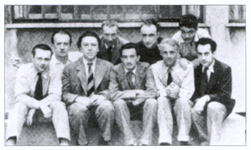
(*)앙드레 브르통의 (1차) '초현실주의 선언'(1924)을 세미나 자료로 올려놓는다. 브르통은 이 선언문에서 '심리적 오토마티즘(Psychic automatism)'을 초현실주의의 핵심적인 규정으로 제시한다: "Psychic automatism in its pure state, by which one proposes to express -- verbally, by means of the written word, or in any other manner -- the actual functioning of thought. Dictated by the thought, in the absence of any control exercised by reason, exempt from any aesthetic or moral concern."

더불어, 사드, 보들레르, 랭보, 로트레아몽, 레이몽 루셀, 심지어 단테의 작품들까지도 '초현실주의 이전의 초현실주의'로 규정함으로써 자신들의 문학사/예술사적 계보를 정립하고자 한다. 이 선언문의 우리말 번역은 송재영 편역, <다다/쉬르레알리슴 선언>(문학과지성사, 1987)에 수록돼 있다. 초현실주의의 역사에 관한 기본 문헌은 모리스 나도의 <초현실주의의 역사>(고려원, 1985; 원저는 1945)이다.
06. 04. 07.
